The Crowd, the Child, and the They-Self
The watching crowd as Heidegger's they-self, and the child who says what everyone sees.
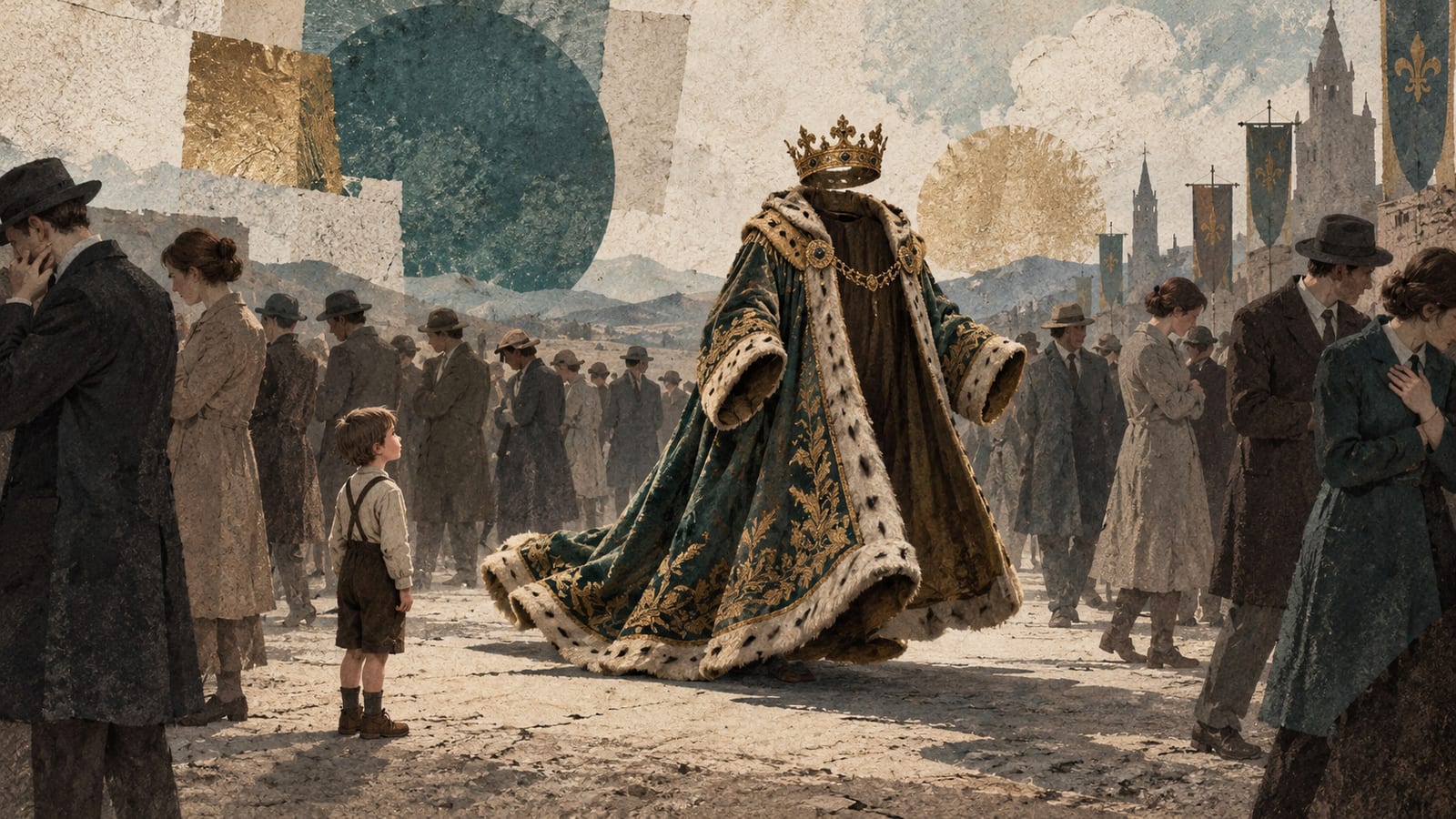
‘The Emperor’s New Clothes’ is a folk tale about an Emperor that was so exceedingly fond of new clothes that he lavishly spent all his money on clothing at the expense of state matters. In the city he oversaw as Emperor, lived rich and vibrant trading and every day many strangers came to town, and among them one day came two swindlers. They claimed to be weavers and said they could weave the most magnificent fabrics imaginable. Not only were their patterns and colours exceptionally fine, but clothes made by them had a magical way of being invisible to those unfit for their office, or for those who were unusually stupid. Being prone to spending on exuberant clothing, the emperor hires them to design him a new coat; one that will both be incomparable in marvel and to expose those around him of hidden ineptitude of office.
The swindlers promptly set up their looms and get to work on the Emperor’s new clothes. As a succession of officials, and the emperor himself, visit the new ‘weavers’ to check their progress, each sees the looms are empty, but pretends otherwise to avoid being thought a fool. Finally, the weavers report the emperor’s new clothes are finished and they mime dressing him; he then sets off in a procession before the whole city to show his opulence. The townsfolk seeing the emperor without clothes uncomfortably go along with the pretence, not wanting to appear inept or stupid. Not until a child cried out “the emperor is wearing nothing at all!” did the people then realise that everyone had been fooled. The emperor, although startled, continued the procession as if nothing were wrong, walking more proudly than ever.
One can see the above story as illustrating, in certain aspects, Heidegger’s notion of the They Self. This is most exemplified by focusing the analysis on the citizens and the boy who cried out, rather than the emperor himself. The citizens ‘see’ the emperor parading through the city apparently without clothes on, but instead of following the inquiry into their own; they instead fall into the averageness of the They Self. In contrast, the boy who cried out that “the emperor is wearing nothing at all!” does manage to explicate this enquiry into his own, bringing forth into the world meaning derived ontologico-existentially by Dasein as a Being-in and as a Being-in-the-world.
The above sentence has quite a few terms that require unpacking to elucidate further; however, for the sake of the brief commentary, I will focus specifically on the key term of ‘They Self’.
For Heidegger, the They Self (Das Man) can be thought of as the ‘world of the other’, the public world we all know and experience. It is the world we experience most in our average everydayness as beings-in-the-world. This world of the They Self provides an understanding of our everyday-self, which can be thought of as our self in its everydayness. However, this understanding is ultimately a dominating one which creates a distantiality from ourselves as Dasein, as it causes us to be concerned with and disturbed by deviations from the prescribed norm – we understand ourselves in the way the They Self understands us. For Heidegger, distantiality is best understood as a flight towards the They Self and away from Dasein-in-itself, which ultimately affects how we interpret and understand the world in its totality, since we become absorbed into the world and hence meaning of the They Self. Ultimately, this distancing and absorption leads to an averageness, or a ‘typicalness’ of how everyone is meant to be and of how everything is.
From this typicalness of the average comes, what Heidegger refers to as a levelling-down. That is, the averageness of the They Self dictates a limited range of possibilities for Dasein-in-its-being. This world, limited in its possibility, feels so concrete and sure to us and is so readily accessible to us that we inevitably ‘fall prey’ to it, becoming tranquilised by it. But as we’ve already touched on, the world of the They Self leads to a type of distancing from ourselves as Dasein-in-itself; thus, this apparently concrete world ultimately leads to an alienation of Dasein from itself through its entanglement with it – the complete absorption into the They Self: Dasein knows itself only through the They Self. Heidegger refers to this entangled state as one of inauthenticity.
On face value this might appear a rather pessimistic perspective. However, there is a possible path out of this aggravating circularity of Dasein’s falling into and subsequent entanglement within the world of the They Self, out of inauthenticity and toward a state of authenticity.
For Heidegger, we are most authentic when we are most connected to ourselves as Dasein and take responsibility and understanding of our possibilities from our own existence, and that such authentic-ness is possible through our state-of-mind or mood - that by which we comport and relate meaning between the world and ourselves. Specifically, it is within the state of angst that we come to view our alienation by the They Self and are able to turn towards ourselves as Dasein-in-itself and can reify our very being and its relation to the world of everydayness; to its possibilities apart and from the limitations of They Self. Moreover, that such acts of authenticity can illuminate the world of the They Self itself; transforming the public (other inauthentic Dasein) of the They Self into people (other authentic Dasein) – in this case, public and people are the relative plural forms of inauthentic and authentic.
We can see many of these characteristics of the They Self within the tale of the ‘Emperor’s New Clothes’. The citizens upon seeing the emperor without clothes conform to the position of the They Self; they subsume their own experienced sight to the common wisdom of the They Self as everyone and no-one. In this sense, each citizen foregoes their own being and responsibility by choosing to ignore what they comport to themselves as being-in-the-world - the nakedness of the emperor – and instead refer authorship of the world and its meaning to anyone else as They Self.
In this sense, the citizens are being inauthentic as that of the public. They know themselves only within the limited possibilities allowed to them as citizens. And because of this the citizens are frozen in a sense of angst as what they see as themselves and how they are meant to act as citizens is in conflict. We can think of this as each citizen not wanting to stand out as singular in fear of threat; in fear of making oneself seen and thus vulnerable to and in such a way of concern to itself. This fear of standing out for the citizen is akin to a fear of death; in that their very existence within the world of the They Self may be threatened through a perceived act of non-conformity. As citizens, their very being does not conform to a possibility of anything beyond the generalised being that is defined as ‘citizen’, and as such their sense of existence itself is threatened; non-existence being equivalent to death.
It is only when the child says that which is clear for all, does the ‘mood’ of the citizens being to shift in an authentic and meaningful way. This shifting of mood from fear of non-conformity, and thus death, to recognition of a shared comportment to the world as beings-with-one-another in the world, allows the citizens to redefine the world of the they Self through their being as Dasein-with within it. In this moment, they stop being simple public beings of the They Self and become people able to impart meaning upon and into it. They are able to both access their own relatedness to the world authentically through a flight towards themselves as a being-in-the-world, as well as re-join the world of the everydayness to which they are most common and is most common to them with self-related and derived meaning; thus being a part of and affecting it in kind.